What It Should Cost
40 repairs priced, with the red flags and the questions on every one.
A homeowner’s heating quote reference
Forty common repairs. Realistic price bands. The red flags, part names and questions that help you decide before you sign.
Current offer price. The regular price is $57. The $37 price has no expiry date.
PDF and EPUB. Free lifetime updates. If the files are not as described or will not open and we cannot put it right, ask us for a refund.
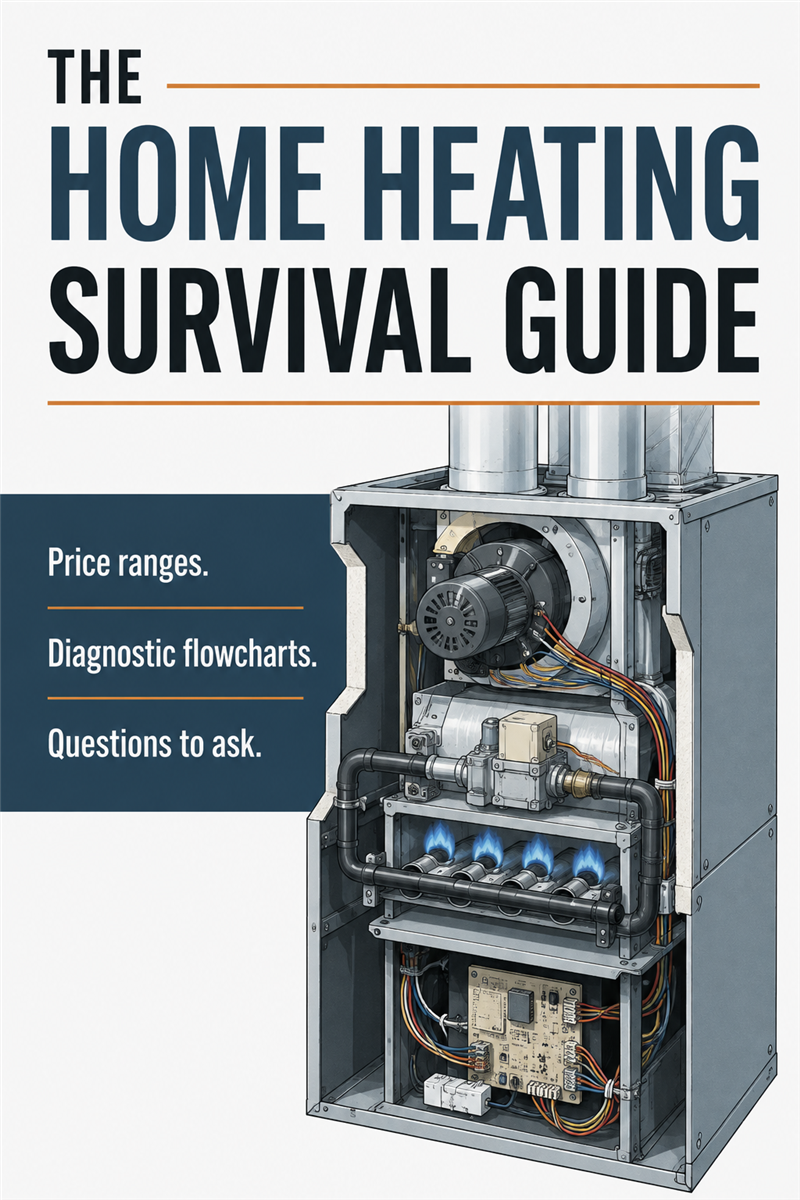
The problem
Your heat stops on a cold morning. A technician arrives with a meter, a vocabulary you do not use, and another appointment waiting across town. Twenty minutes later, there is a number on a tablet. It might be $240. It might be $2,400. You have to answer while the house gets colder.
The person giving you that number knows the equipment. They know the wholesale cost of the part. They know how long the job normally takes and which alternatives were available. You probably know none of those things. That does not make you careless. It makes the conversation uneven.
Most heating companies are not crooked. They have vans, insurance, trained people, dispatch staff and winter overtime to pay for. A part that costs $35 does not produce a $35 invoice. Labour and a properly run service business have real value.
But a legitimate overhead is not a blank cheque. There is still a normal band for a flame sensor, a blower motor, an expansion tank or a control board. There are still tests that should happen before an expensive part is condemned. And there are still quotes that make sense only if nobody asks a second question.
The difficult part is that bad value rarely announces itself. The invoice may use the right part name. The technician may be polite. The company may have hundreds of good reviews. None of that tells you whether a $210 repair became a $680 repair because the appointment was after hours, because the furnace is in a miserable crawlspace, or because the price was simply set at whatever a cold homeowner might accept.
You also need to separate a high price from a weak diagnosis. Those are different problems. A costly ECM blower motor can be entirely real. So can a failed heat exchanger. The question is whether the measurements support the conclusion and whether the proposed work addresses the failure. A lower number does not rescue a guess.
That is why each entry starts with the part and the symptom, then moves through the price band, the things that move the number, the red flags and the questions. You can read the whole subject before the visit. Or you can find one page while the technician writes the estimate.
The aim is not to turn every service call into an argument. It is to slow the decision down by ten useful minutes. Ask for the fault code. Ask what was measured. Ask whether the diagnostic fee is credited. Ask what happens if the same fault returns. A sound diagnosis usually survives ordinary questions.
This guide gives you the missing half of the conversation.
Not a fantasy wholesale price. Not a promise that every job should cost the same. A useful range, the reason it varies, and the question that tells you whether the diagnosis has any weight behind it.
What’s inside
40 repairs priced, with the red flags and the questions on every one.
Four charts: no heat on gas, no heat on a heat pump, weak airflow, the annual health check.
41 scripts for the phone, the basement and the driveway.
For the furnace closet and the fridge.
Read an actual entry
No blurred screenshot. No list of chapter titles doing the work of a sample. This is one complete repair entry, including the numbers.
Gas furnace repair 5
The cheapest real repair in heating
The flame sensor is a thin metal rod that sits in the burner flame and confirms to the control board that the gas actually lit. It accumulates an oxide film, stops conducting, and the board shuts the gas off as a safety measure. The furnace lights for a few seconds and then quits, over and over.
The furnace ignites, then shuts down after three to ten seconds. It tries again and eventually locks out, often after three or four attempts.
| Item | Low | Typical | High |
|---|---|---|---|
| Clean existing sensor, labour only | $90 | $150 | $250 |
| Sensor part | $8 | $18 | $45 |
| Replacement, parts and labour | $120 | $210 | $350 |
| After-hours replacement | $250 | $400 | $600 |
This is one of the more accessible furnace tasks, but opening equipment is not right for everyone. If you are not certain how to isolate electrical power and follow the manufacturer’s instructions, stop and use a technician. Never disturb gas piping, burners or safety devices.
The verdict: $120 to $250 all in is the ordinary band. Above $350 in business hours deserves a clear explanation. This symptom alone does not establish that the furnace needs replacing.
A useful price entry does more than put three numbers in a row. The low figure shows what is possible when access is simple and the work happens in business hours. The typical figure is the centre of gravity, not a legal ceiling. The high figure shows where awkward access, emergency timing or an expensive local market can reasonably land.
Then the non-price evidence has to agree. A furnace that lights and drops out in seconds does point toward flame proving. It does not prove that the sensor is the only possible cause. That is why the entry asks for the lockout code and separates cleaning from replacement. One good question can reveal whether the quote came from a test or from a familiar-looking symptom.
The rest of the repair reference follows the same pattern. The exact details change for igniters, inducer motors, pressure switches, blower motors, thermostats, heat-pump capacitors, circulator pumps and venting work. The method stays steady: identify the component, understand the symptom, place the price in context, and ask for the measurement that supports the diagnosis.
You are not buying authority to overrule the person standing at the equipment. You are buying a reference that makes the conversation legible. That is a smaller promise, and a more useful one. It gives you something firmer than a search result and something calmer than making the decision from a cold hallway.
A fair fit
You do not need to learn a trade to make a better decision. You need enough context to tell the difference between a clear explanation and a rush of technical nouns. The guide is written for that middle ground.
The honest “is not” list matters. A national price reference cannot know that your furnace is behind a finished wall, that the nearest matching part is two states away, or that your town has three technicians booked solid during a freeze. Those facts can make a high quote reasonable.
It also cannot clear equipment for use. Carbon monoxide, flame rollout, damaged venting and gas leaks are not negotiating positions. If the issue is safety, use the guide to understand what you are being told, then follow the direction of the qualified person who inspected the system.
About Dale
Dale Kirkwood is a written character, not a real heating contractor or a person available for consultation. The guides are produced by a small team using manufacturer documentation, trade manuals and published pricing data. Narration on the associated videos is synthetic.
That choice should not be hidden behind a biography. The work stands on the sources, the specificity of the questions, and whether the price ranges are presented honestly. It does not stand on pretending a fictional person made service calls for thirty years.
The Dale voice is deliberately plain because a repair decision is already crowded. You do not need a lecture while standing next to a silent furnace. You need the name of the part, the ordinary band, the exception that might justify more, and a sentence you can actually say out loud.
The team revises the material as equipment, published pricing and documentation change. That is the reason updates are included. It is also the reason no page should be treated as permanent code, a local regulation or a substitute for the manual fixed to your particular machine.
Prices are ranges, not quotes. Region, season, access, equipment and market conditions all move the final number. Use the ranges to judge whether a quote sits in the normal band, not to argue that one specific price must be wrong.
Safety overrides savings. Heating systems involve gas, electricity and combustion products. Anything involving gas lines, flue gases or electrical work belongs with a licensed technician. Nothing in these guides should persuade you to keep running an appliance a qualified person has called unsafe.
The complete bundle
| Included | Pages | Value |
|---|---|---|
| What It Should Cost | 115 | $59 |
| Diagnostic Flowcharts | 10 | $24 |
| Service-Call Defense Scripts | 13 | $19 |
| Print-and-Tape Cards | 2 | $12 |
| Free lifetime updates | — | $12 |
| Total reference value | $126 |
You pay $37; the regular price is $57. This offer has no expiry date. You receive the complete PDF and EPUB. When the team publishes a revision, the updated files are included at no extra charge.
Questions before buying
No. It is a decision manual. It explains symptoms, price ranges, red flags and questions. It does not replace equipment instructions or licensed gas, combustion and electrical work.
No. Labour markets, travel, season, equipment access and after-hours timing vary. Each repair has a low, typical and high figure so you can place a quote in context.
The bundle includes PDF for printing and fixed-layout reading, plus EPUB for an e-reader. Gumroad delivers the paid files and the receipt after purchase.
Yes. Future revisions of this bundle are included at no extra charge. They are delivered through the same email address used at checkout.
A small research and writing team made it from manufacturer documentation, trade manuals and published pricing data. Dale Kirkwood is the written character used to present that work; he is not a real person.
Contact us. We will first replace or correct the files. If we cannot put the problem right, ask for a refund. Your statutory rights are not affected.
Keep the quote in proportion
The complete bundle costs less than most business-hours diagnostic visits and stays on your shelf for the next one.
Use it before the visit to write down the symptom. Use it during the quote to capture the reading and the part number. Use it afterward to compare the proposed price without trying to reconstruct a hurried conversation from memory.
$57
$37
If the files are not as described or will not open and we cannot put it right, ask us for a refund. Safety always overrides savings.
Not ready to buy? Download the free Winter Heating Bill Audit.